
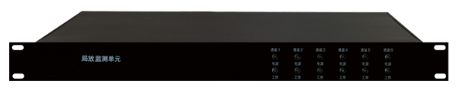
HB-SC7000 Partial Discharge Online Diagnostic Analysis System

The HB-SC7000 Partial Discharge Online Diagnostic Analysis System consists of an ultrasonic partial discharge sensor, an online monitoring IED device, and monitoring and analysis software. The system collects electromagnetic wave signals of 300MHz-1500MHz generated by internal partial discharges in power equipment in real time through sensors. It also collects electromagnetic wave signals of 3MHz-30MHz through high-frequency current sensors. Through demodulation and frequency reduction circuits, high-speed sampling circuits, and data processing buffer circuits, it captures the amplitude (Q), phase (Φ), frequency (N), and wave cycle sequence (t) of partial discharge pulses that meet the triggering conditions, generates event files, and uploads them to the expert diagnostic system for event pattern establishment and insulation status analysis of monitoring equipment.
1、Ultrasonic Acquisition Unit
The ultrasonic sensor serves as the terminal for signal acquisition in the system, which can be deployed simultaneously at different monitoring points of the equipment to avoid blind spots. It adopts a non-contact acquisition method, which does not affect the normal operation of the substation equipment. It specifically captures ultrasonic signals generated during partial discharges in the substation equipment, converting physical sound waves into transmittable electrical signals to provide original data for subsequent analysis. The magnetic suction design ensures secure installation and adapts to different surface shapes of equipment. The binding strap provides auxiliary fixation to resist vibration interference and ensure signal acquisition stability.
2、Integrated Online Monitoring Unit
As the core of data processing in the system, it is responsible for receiving electrical signals from the ultrasonic sensor, performing amplification, filtering, sampling, and digital conversion, while also achieving local data storage and preliminary analysis. As the system's 'central hub', on one hand, it captures minor partial discharge signals through high-speed, high-precision sampling, filters strong electromagnetic interference in the substation, ensuring data accuracy; on the other hand, it stores the digitized signals locally, providing a foundation for subsequent data analysis and traceability, and outputs standardized data to the transmission component.
3、Monitoring Aggregation Module
Monitoring Aggregation Module: An overall device containing TNC, BNC, and N-type connectors, responsible for aggregating and interface adaptation of 8-channel signals to ensure signal transmission without attenuation. The monitoring aggregation module uniformly integrates 8-channel data to avoid conflicts among multi-channel signals, and ensures signal transmission stability through standardized connectors. The data transmission system adopts a dual network redundant design, capable of automatically switching network links to ensure uninterrupted data transmission. It also supports encrypted data upload to prevent information leakage, providing network support for remote access and maintenance.
4、System Software
The system analysis software can display in real time the amplitude (Q), phase (Φ), and number of discharges (N) of partial discharge events, and draw three-dimensional partial discharge spectrograms of events meeting discharge triggering conditions, including Φ-Q-N three-dimensional spectrograms, N-Q two-dimensional spectrograms, Q-t two-dimensional spectrograms, N-t two-dimensional spectrograms, Qmax-Φ two-dimensional spectrograms, Qavr-Φ two-dimensional spectrograms, ellipse diagrams, and three-dimensional gray spectrograms of discharge events in terms of Φ-Q-t. It uses vector machine tools for type identification and provides fault prediction alarms and trend statistics. The software is fully compatible with IEC61850 and DL/T 860 data communication protocols, uploading partial discharge analysis data and results.
HB-SC7000 Partial Discharge Online Diagnostic Analysis System is a platform-level SCADA system based on the IEC61968, IEC61970 (SCADA/EMS) component architecture standards. It adopts an object-oriented and interface-oriented hierarchical distributed architecture, integrating technologies such as COM components, plug-in DLLs, cross-network memory real-time condition databases, TCP/IP and UDP communication technologies, network database technologies, and computer graphics technologies. The system integrates key technologies such as ultrasonic monitoring, high-speed data acquisition, anti-interference signal processing, and wireless remote transmission. Through the coordinated operation of multi-channel integrated monitoring units and ultrasonic sensors, it can capture partial discharge signals in real time. Combined with professional data analysis systems, it realizes discharge parameter statistics, diagram display, trend prediction, and fault alarms, comprehensively preventing safety risks caused by insulation degradation of equipment.
HB-SC7000 Partial Discharge Online Diagnostic Analysis System monitors the discharge conditions of GIS switches, transformers, and other equipment in each interval of the power station. It provides graphical display and recording of real-time operational data for various transformers, busbars, and incoming/outgoing lines within the power station. It offers alarms through methods such as graphic flashing, sound alerts, and pop-up windows. By analyzing discharge data through diagrams, it provides functions for detecting discharge types and alarm levels.
Specifications
System maximum capacity
- Remote measurement
- Design capacity 4096, maximum capacity 16384
- Remote signal quantity
- Design capacity 8192, maximum capacity 32768
Screen call-out and refresh speed
- Screen call response time
- Real-time screen ≤1s
- Real-time discharge spectrum refresh time
- 250ms
Data processing speed
- Remote signal change transmission time
- ≤1s
- Discharge real-time data upload time
- ≤100ms
Data communication
- Station internal communication medium and rate
- Ethernet (10\100Mbps); RS232, RS485 (300-19200bps)
- Central control station communication medium and rate
- Ethernet (10\100Mbps); RS232, RS485 (300-19200bps)
Ultrasonic Sensor
- Vibration Frequency
- 30kHz
- Dynamic Range
- ≥60dB
- Gain
- 46dB±1dB
- Ultrasonic Testing Frequency Range
- 50-200kHZ
- Data Sampling Frequency
- Default: once per hour, with remote frequency band adjustment function
- Installation Method
- Fixed with magnetic strap
- Sensitivity
- Peak Sensitivity>75(V/(m/s))
Integrated Online Monitoring Unit
- Measurement Channel
- 8 Channels
- Sampling Rate
- ≥80MHz
- Support monitoring methods
- Ultrasonic
- Sample accuracy
- 12Bit
- Power supply
- AC220V
- Frequency
- 50Hz
- Power
- 300W
Contact Us

Hotline
400-6371-066

Technical Support
0371-56977878

Sales
0371-56977890 0371-56977880

WeChat Service Account

Douyin

Video Account