
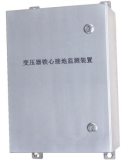
HB-TC10 Transformer Core Clamp Grounding Current Online Monitoring Device

Equipped with a through-type current transformer, isolated from the secondary circuit*, ensuring high safety
Adopts a distributed measurement structure, i.e., local measurement and digital transmission, with protocol conforming to DL/T860 standard
Supports hot installation, i.e., no need to power off the main equipment for installation, convenient and quick access to the system
Uses digital filtering methods to eliminate the 'zero drift' issue caused by analog filters
Equipped with high-precision active zero-flux sensors, intelligently selects conditioning circuits and amplification factors according to the measured current size, effectively improving the measurement accuracy. It also has real-time temperature and humidity measurement functions and can upload data to the backend software, enriching the monitoring information. The operation personnel can view the continuous changes of on-site temperature and humidity information on the backend.
The Wireless Transformer Core/Clamp Grounding Online Monitoring System is used to monitor the grounding fault current of the transformer core and clamp, enabling continuous and online monitoring of the core grounding current. Through monitoring, it can real-time monitor the insulation condition of the equipment and promptly detect faults such as internal insulation dampness or damage, multiple grounding points of the core, foreign objects inside the casing, oil sludge accumulation in the oil tank, etc. It enables early prevention and early handling of accidents, and more importantly, provides reliable data for condition-based maintenance of such equipment. Its working principle is as follows:
The system uses high-precision through-core sensors to convert the grounding current signals on the core and clamp into voltage signals. The voltage signals enter the signal conditioning circuit, which automatically switches the range according to the voltage level. Finally, the signals enter the signal measurement board with a DSP as the core processor. The signal measurement board selects a high-performance 32-bit digital processing chip DSP as the main processor. The grounding current of the core and clamp includes interference signals from the site. When calculating, these interference signals must first be removed. Traditional methods use analog filters to eliminate interference signals, but analog filters are easily affected by environmental temperature and humidity and may produce zero drift over time, thus introducing new 'interference'. The powerful digital computing capabilities of the DSP allow the use of digital filtering algorithms to replace the original analog filtering algorithms. Digital filtering algorithms are not affected by temperature, humidity, or other environmental factors and have no zero drift, solving various problems caused by analog filters. After the signal measurement board calculates the grounding current of the core and clamp, it uploads the data through a digital bus to the interval layer monitoring IED. The interval layer IED uses a unified embedded platform to realize functions such as analysis and judgment, alarm, and remote transmission of data. By monitoring the size of the core grounding current during operation, it can automatically determine whether the transformer core is ungrounded or has multiple grounding points, thereby preventing the formation of floating potential and localized overheating that could lead to a series of faults, ensuring the safe operation of power transformers.
Specifications
Other technical parameters
- Leakage current measurement range
- 0~10000mA
- Measurement accuracy
- ±0.5% or +0.1mA
- System frequency
- 46~60HZ
- Sampling cycle
- ≤5S (adjustable)
- Communication interface
- IEC61850、RS485
- System design service life
- 10 years
Contact Us

Hotline
400-6371-066

Technical Support
0371-56977878

Sales
0371-56977890 0371-56977880

WeChat Service Account

Douyin

Video Account